Hazard assessment
Crew lead (ISA Certified Arborist or senior climber) identifies line involvement, loaded limbs, root plate stability, and structural integrity of the impact point.
It’s 2 AM in Port St. Lucie and a laurel oak just came through the screen porch. It’s the hour after a microburst and a queen palm is leaning into the power drop. When a tree fails on the Treasure Coast, every minute matters and every wrong move costs money. Swift answers a 24/7 human-answered emergency line year-round, not a call center, not an answering service. On-site target: 60 to 90 minutes across all three counties. Certificate of Insurance delivered before any equipment touches the property.
When a tree fails on the Treasure Coast, every minute matters and every wrong move costs money. Swift answers the line at 2 AM with a real dispatcher who has live crew availability, not a recording, not a call center halfway across the country. The full crew rolls on the first dispatch: chainsaws, climbing gear, rigging, chipper, and grapple truck.
Call (772) 773-6676, 24/7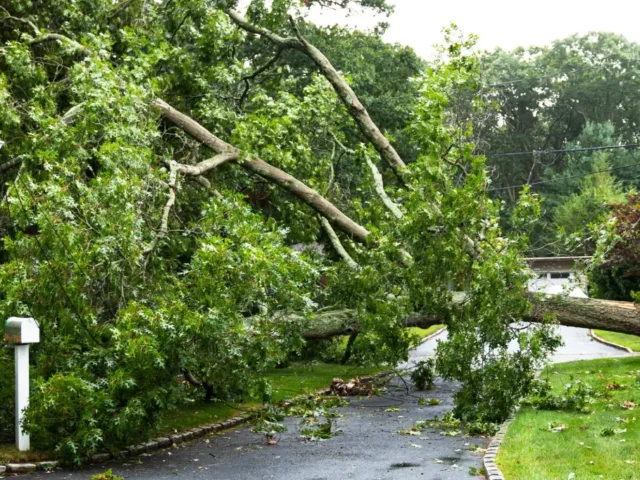
We answer the line either way. Knowing what qualifies as a true emergency helps you make the right decision in the first 30 seconds.
Tree on the structure, trunk or major limb resting on a roof, exterior wall, garage, or vehicle
Power line involvement, any tree, limb, or trunk in contact with primary, secondary, or service-drop lines
Blocked egress, tree across the only driveway, blocking a fire lane, or trapping people inside
Active failure in progress, visible lean, cracked trunk, lifted root plate, or audible cracking
Storm damage with rain coming, open canopy holes over interior space with another front approaching
If a power line is involved, call the utility company first, then call Swift. That sequence is not optional, the utility has to de-energize before any crew can safely work the failure.
Crew lead (ISA Certified Arborist or senior climber) identifies line involvement, loaded limbs, root plate stability, and structural integrity of the impact point.
Cones, caution tape, exclusion radius, clear staging area. Photographs of everything before cutting starts. COI handed to the property owner.
Rigging the failure down in controlled sections, never just cutting and dropping near a damaged structure. ANSI A300 + Z133 compliance even in driving rain.
Debris off the property, tarps in place if needed, written scope for any follow-up work. Itemized invoice for your insurance file.
The single most common large-tree failure across the region. Weak wood, decay-prone. Often misidentified by the homeowner as a healthy live oak. Pattern repeats after every Treasure Coast hurricane.
Shallow root system, top-heavy in wind. Classic snap-and-uproot failure in saturated soil. Common during and after tropical-storm rainfall events.
Brittle wood, shallow roots, Category I invasive. Frequent failure even in moderate wind. Should not be on the property at all, see Land Clearing for proactive removal.
Failure at a tight V-union, often dropping half the canopy. Pre-season cabling to ANSI A300 Part 3 can prevent, see Hurricane Prep.
Summer thunderstorm column collapse, no warning, sound trees losing structural limbs. Most unpredictable failure mode in Port St. Lucie.
Florida Statute §163.045 (amended July 1, 2022) allows a single-family residential homeowner to skip the local tree-removal permit when an ISA Certified Arborist documents the tree as dangerous under ANSI/ISA Best Management Practices for Tree Risk Assessment. For emergency post-failure removals, this pathway often applies. Swift handles the documentation as part of the response. The statute does not cover shoreline trees, HOA common areas, or commercial property. For city-specific permit details, see the 24/7 Emergency Tree Service page for your city.
Our target is 60 to 90 minutes across St. Lucie, Martin, and Indian River counties. During active hurricane events with road closures, response times extend, but we stay on the road as long as it is safe to operate.
Yes. The 24/7 emergency line is human-answered year-round, not a call center, not an answering service. A real dispatcher with crew availability information picks up.
Call the utility company first. Florida Power and Light, City of Vero Beach Electric, or Fort Pierce Utilities Authority depending on your service area. The line has to be de-energized before any tree crew can safely work the failure. Then call Swift.
Most policies cover tree removal when the tree has damaged a covered structure (house, garage, fence, vehicle). Trees that fall without striking a structure are often excluded. We coordinate documentation and provide a written scope your adjuster can work from.
In most cases, your homeowner’s insurance handles the removal and damage, then your insurer subrogates against your neighbor’s policy if negligence is involved. We focus on getting the failure cleared safely. Your adjuster handles the recovery side.
Pricing is reviewed during the on-site assessment, with scope and complexity factors discussed before any cutting begins. We do not quote over the phone for emergencies because the scope is impossible to know until the crew sees it.
Tree on a structure, line involvement, blocked egress, or active failure in progress is an emergency. A leaning tree that hasn’t yet failed, a large hanger limb, or storm damage without structural impact is usually same-day work, not 2 AM work. Either way, call us and we will help triage.
Yes. The emergency response, removal, stump grinding, debris haul-off, and any follow-up structural pruning route through the same scope. You work with one crew, one COI, and one written invoice.
Florida Power & Light, City of Vero Beach Electric, or Fort Pierce Utilities Authority depending on your area. Report the location and request de-energization.
Get people, pets, and vehicles out of the strike zone and out of any room with a tree on the structure.
Wide shots, close shots, the failure point, the impact point, interior damage, exterior damage. Timestamps on. Before anyone touches anything.
Loaded limbs, lifted root plates, and partially failed trunks shift without warning, even minutes after the initial failure.
Have the address, a quick description, and whether a line is involved ready for the dispatcher. Photographs taken in the first 10 minutes are the single most useful piece of evidence in a storm damage insurance claim.
A fallen tree is an adjuster problem, and sometimes a roof and structural problem stacked on top. Swift coordinates the tree work with the claim from the first phone call, multi-angle damage documentation on arrival before any work starts; a written scope your adjuster can read and approve; tarping and temporary stabilization to prevent additional weather damage before the structural repair crew arrives; coordination with restoration contractors so the tree work does not block the roof work; and an itemized invoice broken out by removal, debris, stump, and emergency response time. For removals that follow the emergency, the work routes through our Tree Removal service inside the same mobilization, so you’re not waiting on a second crew.
A laurel oak came down on my screened porch at 11 PM during a squall. Swift answered on the first ring, crew was on-site in 75 minutes. Full photo documentation ready for my insurance adjuster by morning.
Tree on my car after the storm. Swift triaged on the phone in under a minute, dispatched a crew, and photographed everything for my insurance claim before making a single cut. Insurance covered the full removal.
As a Hurricane Subscriber, Swift called me. I didn't have to call them. Priority dispatch, crew here before my neighbors even got a callback from their regular contractors. The subscription pays for itself on a day like that.
Same-day on-site assessment · Written quote in 4 hours · Fully insured · Family-owned